6 HARP2 L2 Validation (DITL)
6.1 Overview
Pre-launch Day-in-the-Life (DITL) simulations provide an end-to-end benchmark of HARP2 measurement realism, L2 retrieval performance, and uncertainty characterization. The results below highlight three key aspects: synthetic observations, pixel-wise retrieval performance, and uncertainty analysis. Details are provided in Gao et al. (2023).
Validation of the production data (V3 and V4) is ongoing, following the methodologies reported in Gao et al. (2026). The validation results should be compared with the DITL uncertainty analysis to assess retrieval performance using real observations relative to theoretical expectations.
6.2 Summary Information
- FastMAPOL version: Prelaunch Test
- Data period: March 21, 2022 (spring equinox)
- Reference: Synthetic HARP2
- Published: Dec 07, 2023 (https://doi.org/10.5194/amt-16-5863-2023)
6.3 Synthetic HARP2 observations
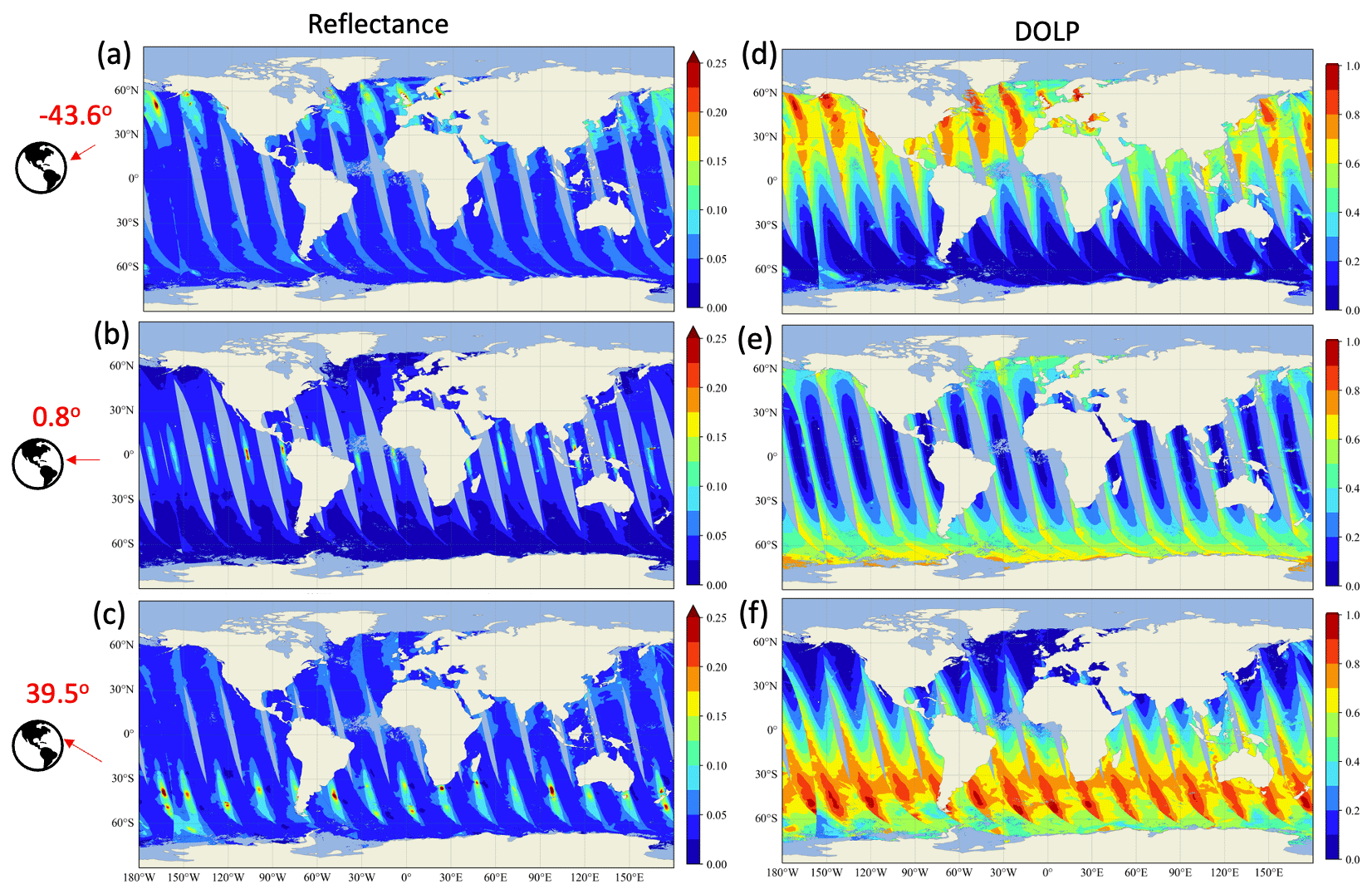
As shown in Figure 6.1, A full day of synthetic HARP2 observations is generated using a neural network forward model for both reflectance and DoLP. Aerosol and surface properties are prescribed from reanalysis (MERRA-2). The simulated observations provide a realistic testbed for retrieval evaluation:
- Global multi-angle measurements are generated for both reflectance and polarization.
- DoLP shows enhanced sensitivity to aerosol and surface properties.
- Reflectance and DoLP provide complementary information content.
6.4 Geophysical retrievals with pixel-wise uncertainty
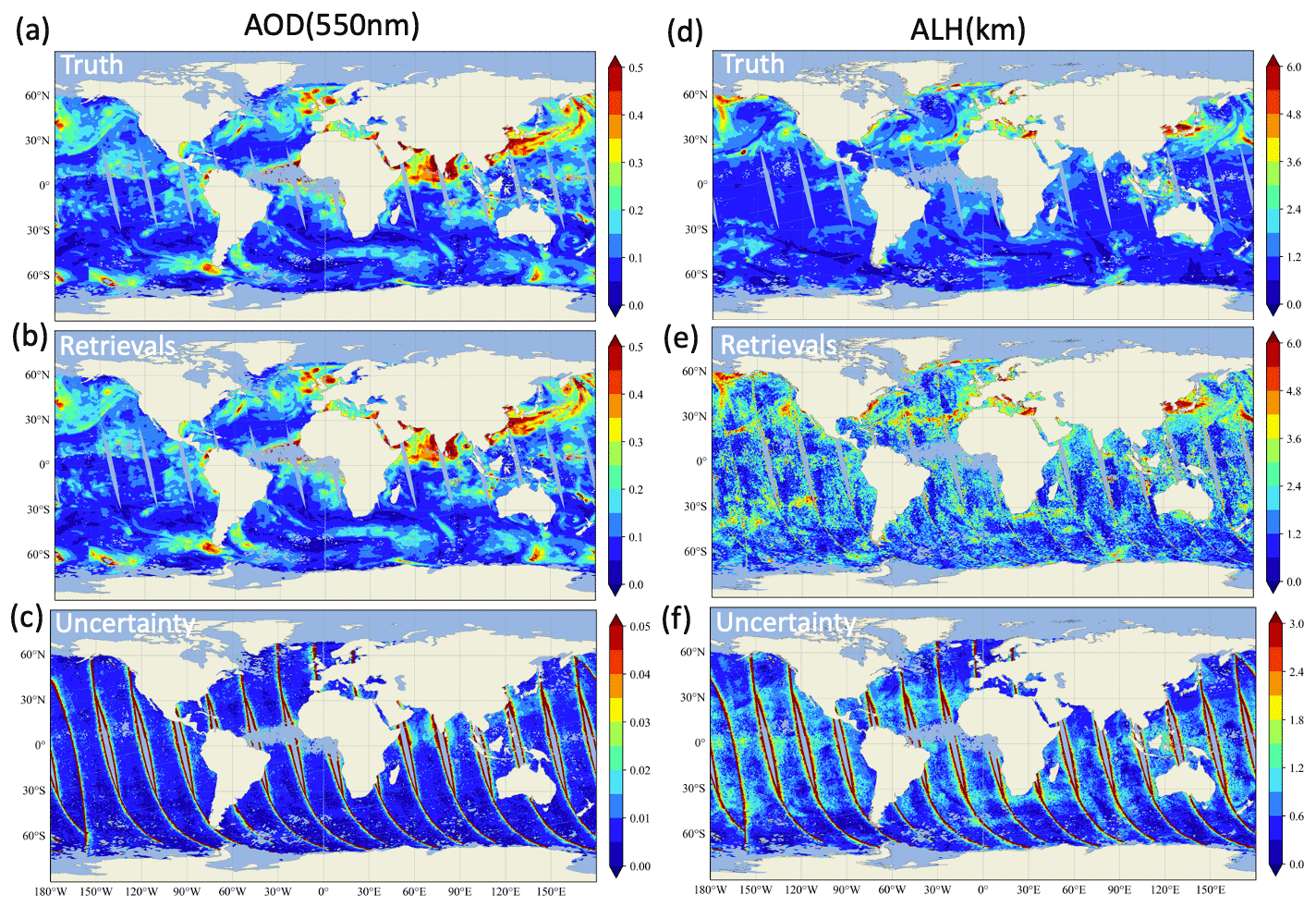
Based on the synthetic data, retrieval results as shown in Figure 6.2 demonstrate strong agreement with truth and meaningful uncertainty estimates:
- AOD (550 nm) is retrieved with high accuracy and low spatial error.
- Multiple geophysical variables are retrieved simultaneously, with ALH shown as an example.
- Pixel-wise uncertainty reflects scene dependence, with larger values at low AOD and limited angular sampling.
6.5 Uncertainty closure analysis
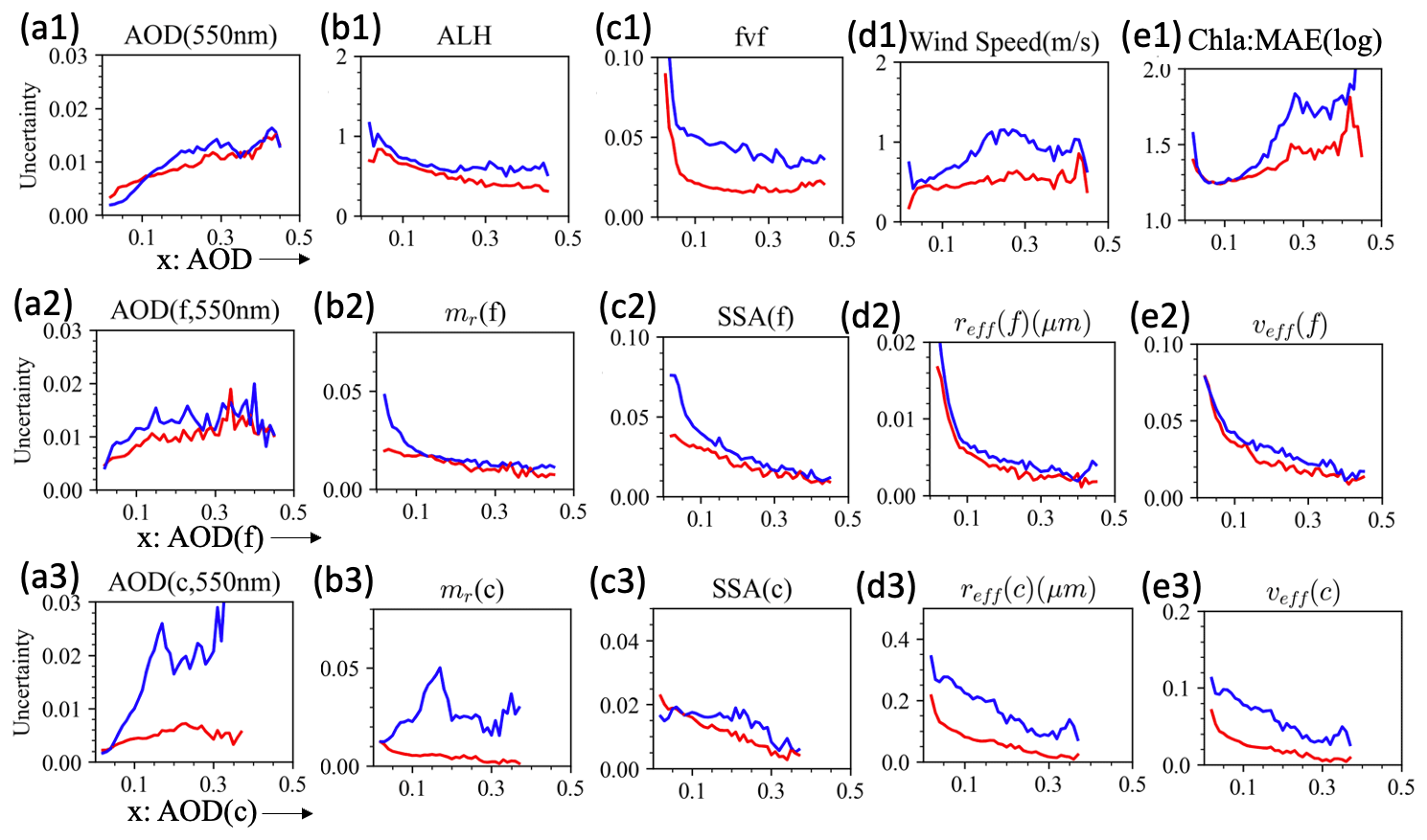
Theoretical uncertainties are derived from error propagation, while realized uncertainties are computed from retrieval–truth differences. Their comparisons are shown in Figure 6.3,
- Good agreement for aerosol optical and microphysical properties, especially at moderate to high AOD.
- Decreasing uncertainty with increasing aerosol loading.
- Underestimation of uncertainty in low-AOD conditions and for weakly constrained parameters.
6.6 Summary
- Synthetic data provide realistic multi-angle polarimetric observations.
- L2 retrievals achieve high accuracy for key variables (especially AOD).
- Pixel-level uncertainties are physically meaningful and scene dependent.
- Uncertainty estimates are generally consistent with actual errors, with known limitations.
These results define a pre-launch benchmark for HARP2 L2 validation using DITL data.